The Cambridge University Press dictionary defines “resilient” as:
- The ability to be happy or successful again after something difficult or bad has happened.
- The ability to quickly return to a usual shape after being bent, stretched, or pressed.
- The ability to improve quickly after being hurt or being ill.
- The ability to return quickly to a previous good condition after experiencing problems.
Definitions 2 and 4 clearly indicate the return to a previous condition following a disturbance. Whereas definitions 1 and 3 are less clear, suggesting the return to a positive condition, but not necessary the same condition.
With respect to urban resilience, is it necessary for the system to return to the same condition following a disturbance to be considered resilient? Or can resilience refer to adaption and transformation following disturbance? I.e., what do we mean when we say urban resilience?
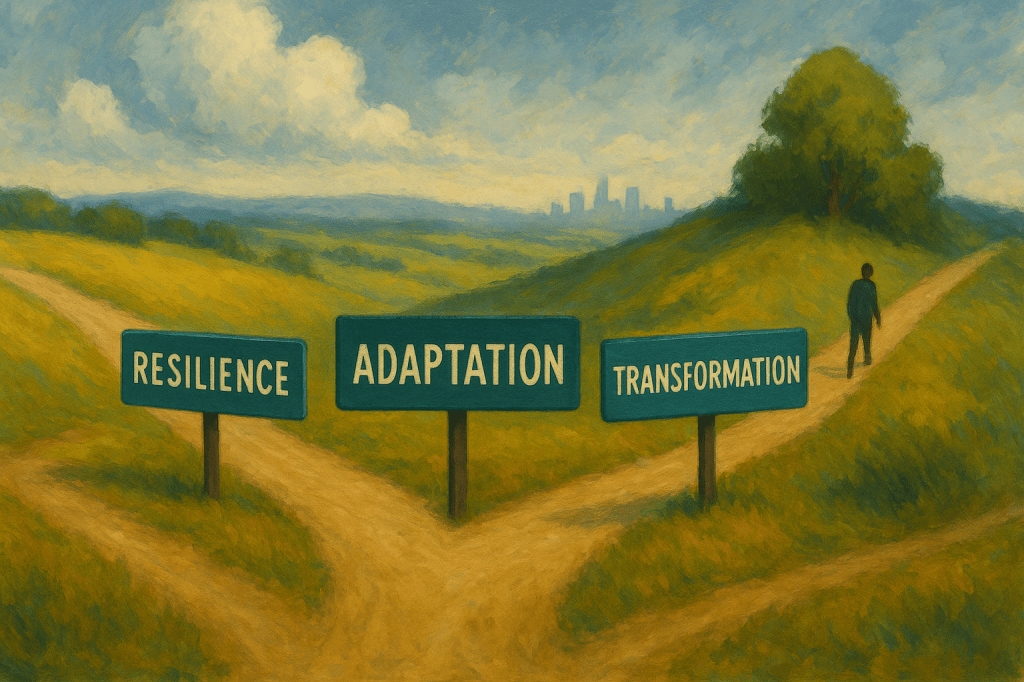
Resilience vs. Adaptation vs. Transformation
In their discussion on the applicability of the concept of resilience to social systems, Davidson distinguishes between resilience, adaptation, and transformation by saying:
“…three possible outcomes can occur: the system can reorganize and remain within the same structural regime with no notable changes in structure or function (resilience); …it can shift to a different state within the same regime…(adaptation); …or it can transform to a new regime altogether (transformation)…”
Moreover:
Resilience itself should be understood as one of three possible responses to disturbance, with the other two being adaptation and transformation, and the researcher should not presume ipso facto that resilience is necessarily the preferred response.
These definitions differ from those used in the context of extreme events. For example, Carpenter et al. say that “resilience is the capacity of social-ecological systems to adapt or transform in response to unfamiliar, unexpected and extreme shocks.” And in the context of urban systems, Koren et al. say that “resilience is a capacity of a complex urban system, composed of interacting physical and social components, to withstand an external stress and bounce back to a state of equilibrium or bounce forward to improved new states of equilibrium.”
Unfortunately, there is no consensus on what these terms mean, which is a common issue in academia. As researchers dive deep into theories and terminology, they often add complexity and ambiguity. When dealing with a wicked problem like climate change—where experts from various sectors and disciplines come together—this complexity is likely to cause confusion and, ultimately, create project roadblocks. This lack of clarity can hinder progress when clear communication is most needed.
At this point in my urban resilience studies, I do not have enough information to form a definitive opinion. However, I see merit in both perspectives. If resilience can mean both returning to a previous state and moving forward to a new one, it overlaps with adaptation and transformation, making the term redundant. But in the context of urban resilience and climate change, resilience acts as a useful catchall and rallying point, even if its ambiguity might hinder progress. This is worth exploring further in discussions with urban resilience project stakeholders.
 Urban Solutions